

I’m publishing Bluecut Rills, a golf comedy about a scrappy course trying to survive a developer named Fred Falloon.
I’ve always loved oblivious comedic villains—Judge Smails in Caddyshack, Tony Perkins in Heavyweights. Fred was my attempt to create one.
Here’s a scene from the first chapter where he shares his vision.
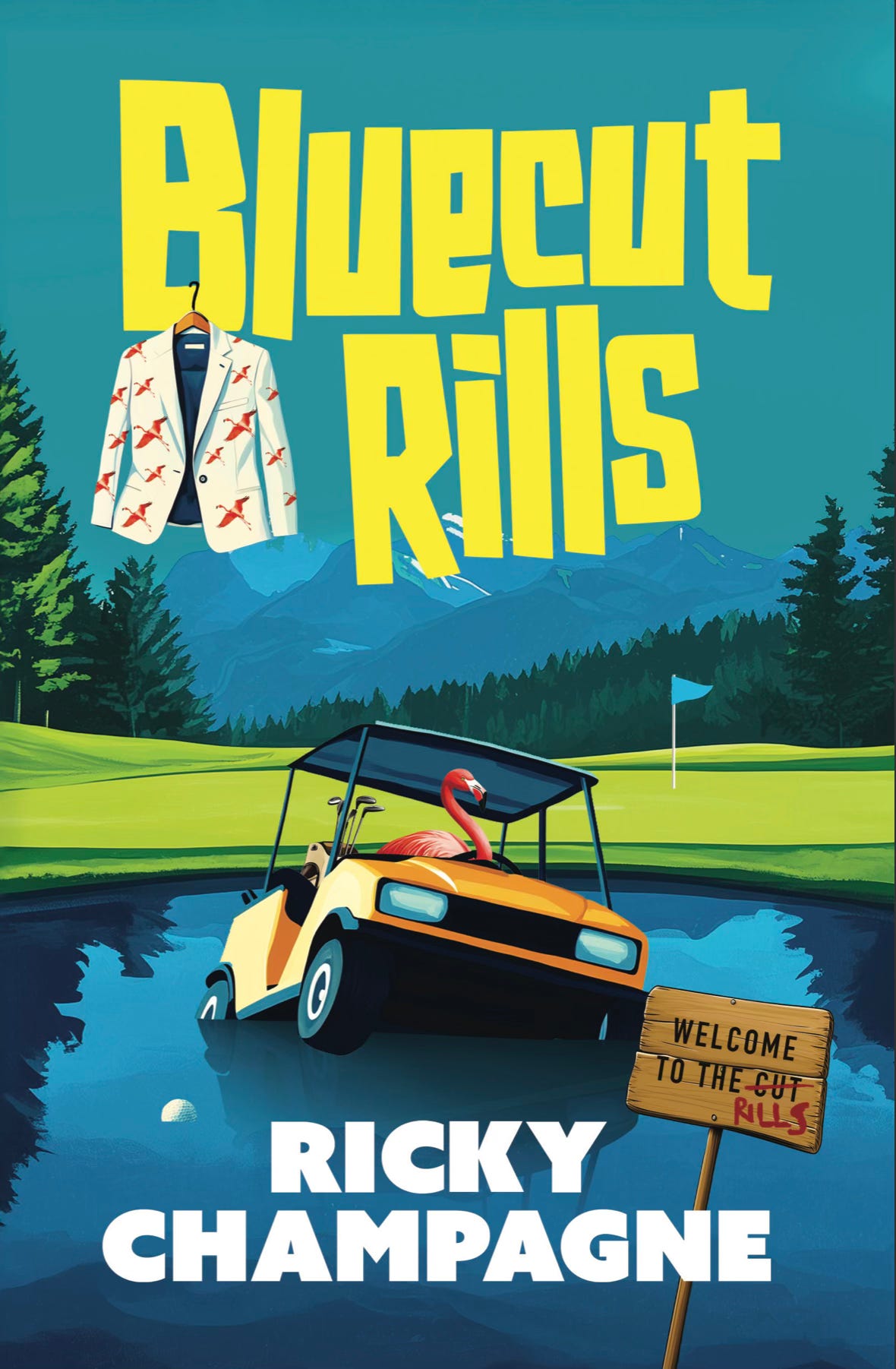
Fred Falloon, local real estate developer and guardian of unchecked sprawl, sat perched on a barstool that looked like it had been stolen from a saloon-themed amusement park. His pinky ring clinked against the rim of his glass as he swirled a double Scotch. He wore a white blazer with embroidered flamingos flying skyward, as if they were trying to escape his poor taste.
The nicest hotel in Bluecut Rills promised “rustic refinement” and mostly delivered, right up until you found The Water Hazard, the dive bar tacked onto its backside. It was quiet, private, and had the sort of wear-and-tear that kept people with networking agendas away. Maybe that’s why Fred liked it, though he’d never admit he was a regular.
He sniffed. “Smells like Windex and wet naps in here. You must have a date.”
The bartender, a part-time wedding DJ named Dennis who insisted on being called Denali, as confirmed by his Sharpie-marked name tag, just nodded. Experience taught him that Fred’s comments were rarely meant for anyone but himself.
“Denali, let me ask you something. You ever play golf?”
Denali was polishing a martini glass with a threadbare rag, stained and frayed from years behind the bar. “I work here, man. What do you think?”
“Exactly,” Fred said, pointing a knuckle at him. “Exactly. You’re not burdened by the lies of the game. You don’t pretend that walking five miles in ugly pants chasing a tiny ball makes you better than anyone else. That’s real freedom.”
He took a long sip, grimaced, and continued. “Me though? I’m a prisoner to it. Because golf, golf is how you get to the soul of a man. You can’t lie on a scorecard. Well, you can, but it’s a spiritual lie. And I don’t trust spiritual liars.”
Fred shifted on his stool and looked past Denali. He stared through the bar’s smeared window at the town beyond. Its flickering neon signs, the weathered shingle roofs, the outline of Bluecut Rills Golf Club, just past the tree line. A smug grin crept across his face. He could practically feel his bank account growing.
“You know the thing about those Wicksell boys?” Fred said. “They’re like rust. Not dangerous right away. But leave ‘em alone long enough, and they’ll ruin good metal. That real estate is a gold mine, and those turds are squandering it.”
He swirled his drink and scoffed. “It was supposed to be my year. Senior year. All the scouts were watching me. Then he shows up as a freshman, and breaks every damn record I set before my spikes were even dry. I was the name at that school. Then Knut saunters in, swing like a poet, attitude like a happy hour meatball. Please. I’ve seen better motions in a toddler’s birthday piñata line.”
He jabbed a thumb at his chest. “I had to grind for everything. He breezed through, smug and naturally better at the one thing I cared about.”
Fred took another sip, then clinked the glass suggestively toward Denali. After a few awkward moments between the two men staring at each other, Denali obliged with a top-off.
“Knut thinks he’s some kind of folk hero, walking around barefoot quoting bumper stickers and Fred Flintstone—next thing you know, he’ll be pedaling a giant stone wheel. And Arnie? Come on. That man probably tries to itemize paperclips. He’s a spreadsheet away from a nervous breakdown.”
He jabbed his thumb again. “I’ve got vision. Plans. Capital. Connections. I know how to take something broken and make it profitable. That’s what separates me from those two. I don’t get sentimental. I succeed. End of story.”
“Sure,” Denali said, in a way that meant nothing at all.
Fred kept going. “I mean, take a ride by the course sometime. You should see it.”
He hesitated, trying to picture how someone like Denali lived. Did they have cars? A kitchen? “Do people with name tags even get days off?”
Denali broke into a yawn that could also have been the beginning of a response, but was waved away by Fred.
“Eh, never mind. It’s a mud patch with flagsticks. I could have a five-diamond resort built on that land in six months. Rooftop hot tubs. Automated cocktail carts. No tipping. No talking. And of course cucumber towel service.”
He paused, waiting for affirmation. Denali shrugged.
Fred continued a while longer, fantasizing out loud about fairway condos and his name etched in stone above the clubhouse door. After draining his cup, he stood and flipped a $25 poker chip in Denali’s direction.
“In the biz, we call that a little seed money, dippy,” he said.
Denali watched the chip roll and tumble off the bar top. There wasn’t a casino within 50 miles of town. Unwilling to risk a further conversation with Fred Falloon, he went back to drying glasses.
So that’s Fred. He gets worse.
See you soon,
— Ricky C.